




 TIME:2021-06-18 15:37


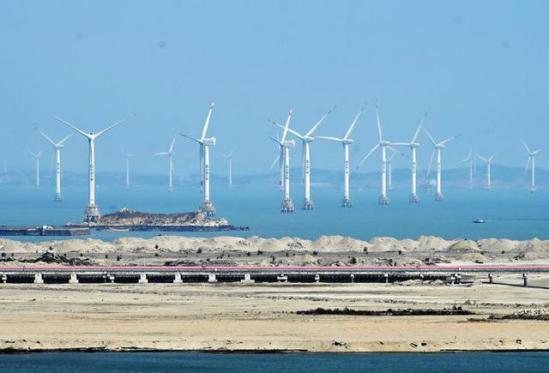
Located at Xinghua Bay in Fuqing, Fujian province, this wind power farm is the world’s first experimental farm for prototype high-capacity offshore wind power turbines, whose installed capacity reaches 357,400 kW, with an annual output of 1.4 billion kW-h.
This wind farm has been developed and operated by a new energy subsidiary of the China Three Gorges Corporation, which is the developer and operator of the super project, Three Gorges Project.
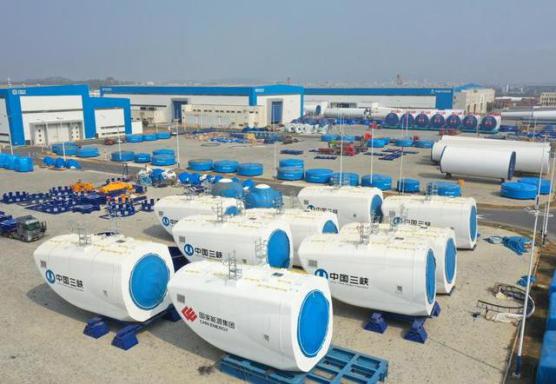
A scene of the Fujian Three Gorges Offshore Wind Power
International Industrial Park (drone photo)
China has established the goals of peaking carbon dioxide emissions before 2030 and becoming carbon neutral by 2060. Clean energy sources, such as Photovoltaics and wind power and so on, are significant paths for achieving these two goals for carbon reduction, and have therefore received great interest from the world.
As the offshore wind power technologies for equipment manufacturing and installation have gone through successive breakthroughs, with relevant costs decreasing year by year, the value of developing and utilizing offshore wind power is getting increasingly obvious and the wind power industry has entered the track of fast development.
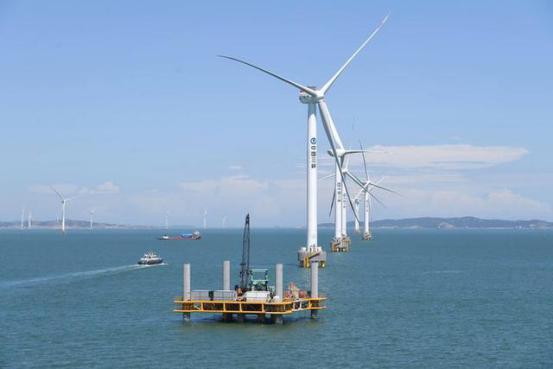
China Three Gorges’ Xinghua Bay II Offshore Wind Farm
at Fuqing County, Fujian Province (drone photo)
In 2020, China’s wind power industry had a newly added installed capacity of 3.06 million kW, comprising 50% of the global figure of that year. Due to the relatively small scales and high costs at present, China’s offshore wind power still falls behind that of Europe to some extent.
Lin Boqiang, Head of China Institute for Studies in Energy Policy of Xiamen University, said that according to experience from developing onshore wind power, in addition to technological advance, the scale development and the coordination throughout the entire industry chain are also important factors in reducing costs. According to him, the development of offshore wind power in China has obviously not yet reached the level of rapid cost reduction.
Another barrier for the development of offshore wind power in China is the increasingly limited offshore wind farm resources. As the concept of ecological protection has taken root in hearts of Chinese people, areas, such as mangroves, coral reefs, important estuaries, important tidal flats and designated islands, habitats of rare and endangered species, and important spawning grounds for fishery resources and so on, have been included in the marine ecological zones for protection, and therefore cannot be used for offshore wind power.
In addition, according to requirement from the State Oceanic Administration of China, offshore wind farms should not be deployed along bird migration paths. Adapting offshore wind power to the survival of birds has become another issue faced by wind power developers.
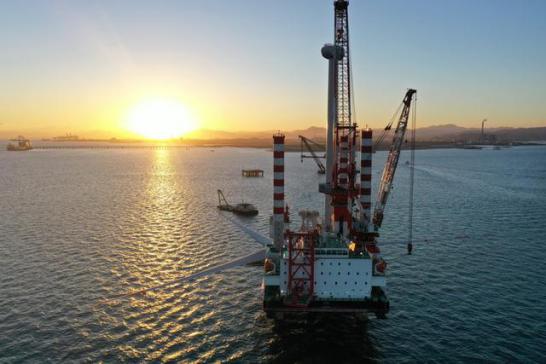
Scene of the installation of the 10 MW wind turbine at China Three Gorges’ Xinghua Bay II
Offshore Wind Farm at Fuqing County, Fujian Province (drone photo)
Under the pressure from multiple aspects, moving towards outlying ocean waters has become the choice for the development of offshore wind power in China.
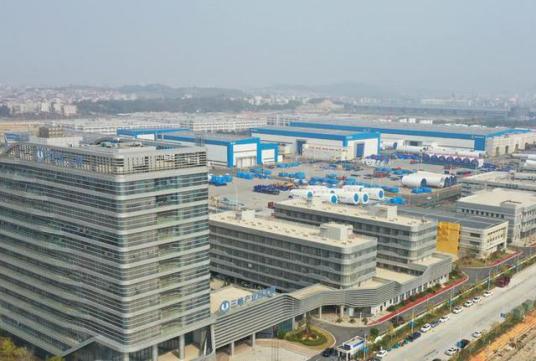
A scene on March 12th of the Fujian Three Gorges Offshore Wind Power
International Industrial Park (drone photo)
As offshore wind power is a technology-intensive industry, cost reduction and efficiency enhancement brought about by technological innovation is the key to its sustainable development. Dolf Gielen, director of IRENA Innovation and Technology Centre in Bonn, said in a video speech at the Clean Energy Strait Summit that 70% of the technical potential of offshore wind power will come from outlying ocean waters that are suitable for deploying floating turbines.
"With rapid technological advancement in various fields, such as high-capacity offshore wind turbines, floating foundations and flexible DC technology, in the context of seeking carbon neutrality, China's offshore wind power will go further and become an important force in peaking carbon dioxide emissions by 2030 and achieving carbon neutrality by 2060", said Wang Zhongyao, Deputy Director of China Renewable Energy Engineering Institute.
Source: Xinhua News Agency
Journalist: Zhang Yizhi, Mi Yingting
Photographer: Lin Shanchuan
Translation: the Committee Secretariat


OFFICIAL WECHAT
Email:
secretariat_21cmcc@163.com
Telephone:
+86-591-83532970
+86-591-83533101
Fax:
+86-591-83531520
Address:
Room 728, Building 3, Eastern Municipal Government Office Compound, 193 South Riverside West Avenue, Cangshan District, Fuzhou City, Fujian Province, China
Set As Default Home Page|Add To Favorites|CONTACT US
Copyright: © 21st-Century Maritime Cooperation Committee Public security record number:35010402351060 闽ICP备2020019451号
 Close
Close File:
File: