




 TIME:2026-06-22 17:55


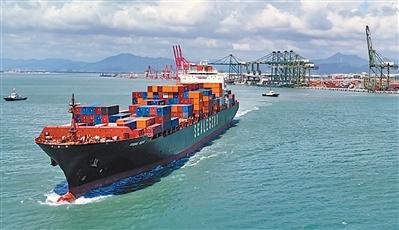
(Image: The Jiangyin Port, located on the northern shore of Xinghua Bay in Fuqing City, as a cargo ship sets sail. Photo source: Fuqing City Convergence Media Center)
Bays are critical areas for promoting the sustained improvement of the marine ecological environment. The "15th Five-Year Plan" proposes strengthening the overall planning for major bays. The "Action Plan for Enhancing the Construction of Beautiful Bays" specifies that by 2027, the construction of over 110 beautiful bays will be prioritized.
In Jiangxia Village, Shapu Town, Fuqing City, Fuzhou, Fujian Province, aquaculture farmer Chen Yunbin looked out at the blue sea and calculated last year's harvest. "The yield per mu of kelp and gracilaria increased by over 20%, and the quality also improved. This is thanks to the improving water quality in Xinghua Bay," said Chen.
The Fuzhou section of Xinghua Bay, where Jiangxia Village is located, has a mainland coastline that stretches from Shapu Town in the east to Xincuo Town in the west of Fuqing City. At the end of last year, the Fuzhou section of Xinghua Bay was designated as the fourth batch of national-level beautiful bays and was also awarded as an outstanding case of beautiful bay construction. While hosting a national-level port and industrial zone, this area has simultaneously seen its environment become cleaner and its industries shift towards greener practices, forming a development model for a green industrial-type beautiful bay.
Addressing Both Symptoms and Root Causes: Clean Seas and Ecological Protection
Having been in the aquaculture business for over 20 years, Chen Yunbin's biggest fear is typhoon season. "When a typhoon hits, the wind and waves wash debris from the sea into the nearshore waters, often tearing the kelp and gracilaria," Chen said. He also noted the trouble caused by floating foam buoys drifting on the sea. "When foam particles shed from the buoys stick to the kelp and gracilaria, it hinders their growth and causes significant losses."
"Shapu Town has a marine aquaculture area of 24,000 mu," explained Lin Jicai, Level II Principal Staff Member of Shapu Town. During typhoon seasons or astronomical high tides, the coastline is prone to accumulating marine litter such as foam buoys and discarded fishing nets, which negatively impacts the growth of marine products.
At the end of 2021, Fuzhou City established maritime sanitation teams organized by county (city, district), and Fuqing City also fully rolled out its maritime sanitation efforts. "Shapu Town has deployed 20 professional sanitation workers, one compactor truck, and two collection vessels to carry out patrol-based cleaning of the sea surface and shoreline within 200 meters of the coast on a rotating basis, achieving normalized cleaning across the entire shoreline," Lin Jicai said.
Addressing the symptoms was only half the battle; tackling the root causes was also essential.
Starting at the end of 2021, Fuqing City initiated an upgrade program for marine aquaculture, converting traditional fishing rafts into plastic aquaculture rafts and upgrading the foam buoys used for long-line suspended culture to environmentally friendly plastic buoys.
"The government subsidized 50% of the cost. As soon as I learned about the policy, I immediately replaced mine," Chen Yunbin said. In 2022, he replaced all his foam buoys with plastic ones. "Now, everyone's aquaculture facilities have been upgraded, and there's no more random foam drifting around."
Lin Jicai explained that Shapu Town has also established a system for centralized collection of household waste from fishing rafts at sea, guiding fishermen to equip their rafts with waste storage containers. This is complemented by an improved waste collection and transfer system for coastal villages, achieving a "village collection, town transfer, county disposal" model.
The combined approach to symptoms and root causes yielded immediate results. In the Hutou Bay shoreline section where Shapu Town is located, the marine litter density dropped from 256 square meters per kilometer in 2022 to 116 square meters per kilometer in 2025.
"With marine products selling well, tourism has also developed," said Chen Yunbin. "In the past couple of years, the town has developed coastal tourist attractions. In summer, the seaside is full of tourists, and homestays in the village are fully booked, bringing tangible economic benefits."
Land-Sea Integration: Controlling Pollution at the Source
The problem of bay environmental governance lies in the sea, but the source is on land. Fuzhou City formulated the "Beautiful Bay Protection and Construction Plan (2024-2035)," specifying a "one bay, one policy" implementation plan. After thorough research by expert teams, strengthening the integrated management of land-based sources was placed as the top priority in the measures for managing the Xinghua Bay, Fuzhou. Concurrently, Fuqing City issued the "Several Measures for Accountability in Comprehensive Water Management in Fuqing City" to supervise relevant units in fulfilling their responsibilities regarding water quality control and enhancement at sea entry points.
Ni Wenqiang, Deputy Chief of Fuqing City Bureau of Ecology and Environment, Fuzhou Municipality, explained that the Jiangyin Port Economic Zone on the northern shore of Xinghua Bay is a specialized chemical new materials zone, one of Fujian Province's "two bases and one special zone" for the petrochemical industry, with the output value of industrial enterprises above designated size reaching 123.88 billion yuan in 2025.
"We learned a hard lesson from failing to properly coordinate economic development and ecological environment protection," Ni Wenqiang recalled. In 2019, the Second Central Ecological and Environmental Protection Inspection Team pointed out issues in the Jiangyin Port Economic Zone, including illegal wastewater dumping by enterprises and failure to implement the upgrading and renovation tasks for the sewage treatment plant. "While industry was developing rapidly, environmental protection infrastructure lagged behind. Learning from this painful experience, the Jiangyin Port Economic Zone carried out an above-ground pipeline renovation for its sewage network and upgraded its sewage treatment plant," Ni Wenqiang said.
In the Jiangyin Port Economic Zone, steel pipe corridors line the roads, with pipes crisscrossing overhead. Gray pipelines, labeled with different company names, run along these corridors – these are the newly constructed above-ground sewage pipes.
"Originally, the sewage pipelines in the Jiangyin Port Economic Zone were underground. On one hand, ground subsidence caused pipe damage and leakage; on the other hand, underground pipes made it difficult to effectively monitor and enforce regulations on enterprise wastewater discharge," said a relevant staff from the Jiangyin Port Economic Zone Management Committee. All industrial enterprises within the zone are now connected to the Jiangyin Sewage Treatment Plant via a "one enterprise, one pipe" system. The treatment capacity of the Jiangyin Sewage Treatment Plant has been increased from 40,000 tons per day to 80,000 tons per day, and its effluent meets the Grade A standard of the "Discharge Standard of Pollutants for Municipal Wastewater Treatment Plant." By the end of 2025, the Jiangyin Port Economic Zone had constructed or renovated approximately 41.5 kilometers of pressurized above-ground sewage pipelines.
Zheng Deyuan, Level III Division Rank Official of Fuzhou Municipal Bureau of Ecology and Environment, introduced that Fuzhou City adheres to the principles of land-sea integration and coastal-marine coordination, connecting source control, process management, and end-point restoration. The city has implemented a full-chain approach to the "inspection, testing, tracing, treatment, and management" of sea-entering outfalls, and has completed centralized industrial wastewater treatment for all 14 provincial-level or higher industrial parks within the city.
Energy Saving and Emission Reduction: Greening the Industry
Entering the Fujian Three Gorges Offshore Wind Power International Industrial Park within the Jiangyin Port Economic Zone, towering wind turbine blades rotate slowly, and a photovoltaic system covering over 100,000 square meters is neatly arranged on the factory rooftops.
"The wind power system and rooftop solar PV system within the park generate approximately 58 million kWh of electricity per year, meeting about 50% of the park's total electricity consumption with 'green electricity'," said Chen Qingsen, Deputy General Manager of Three Gorges Industrial Park Operation Co., Ltd.
The office building near the factory also features "green" design elements. "This building uses construction materials with excellent thermal insulation properties, effectively reducing the need for air conditioning. The building's design also maximizes natural lighting, minimizing the use of artificial lights," Chen Qingsen said. He added that the building incorporates a dedicated rainwater harvesting system, which supplies water for landscaping within the office area.
Through carbon reduction measures such as green energy substitution and energy conservation, combined with the purchase of green electricity certificates, the Three Gorges Industrial Park successfully obtained a "carbon neutrality" certificate from the Beijing Green Exchange in May 2021, becoming a carbon-neutral industrial park.
Xinghua Bay is not only turning greener but also more innovative. Last August, the world's largest 26-megawatt-class offshore wind turbine, independently developed by Dongfang Electric Corporation, was successfully hoisted at the Dongying Offshore Wind Power Equipment Testing and Certification Innovation Base in Shandong, setting two world records for installed single-unit capacity and rotor diameter of a wind turbine. This turbine was manufactured and assembled at the Three Gorges Industrial Park.
Chen Qingsen noted that the Three Gorges Industrial Park has attracted leading companies such as Goldwind and Dongfang Electric, and now possesses the capacity to produce over 3 million kilowatts of wind turbines and their key components annually. It has formed a wind power industry cluster integrating technology R&D, equipment manufacturing and testing, equipment installation and O&M, and talent cultivation and training.
Xinghua Bay itself has also become an offshore wind farm. Looking out along the coastline of Xinghua Bay, numerous wind turbines stand proudly on the blue sea, their blades turning slowly in the sea breeze.
Currently, the Xinghua Bay offshore wind farm operates 59 wind turbines with a total installed capacity of 357.4 MW. Since it began operation, it has generated over 7 billion kWh of electricity, equivalent to saving approximately 2.1 million tons of coal consumption and reducing carbon dioxide emissions by about 5.3 million tons.
"We will continue to use high-level protection of the bay's ecological environment to promote high-quality economic development in the bay area, achieving a higher level of synergy between environmental governance and industrial upgrading," said a relevant official from Fuzhou Municipal Bureau of Ecology and Environment.
Source: People's Daily


OFFICIAL WECHAT
Email:
secretariat_21cmcc@163.com
Telephone:
+86-591-83532970
+86-591-83533101
Fax:
+86-591-83531520
Address:
Room 728, Building 3, Eastern Municipal Government Office Compound, 193 South Riverside West Avenue, Cangshan District, Fuzhou City, Fujian Province, China
Set As Default Home Page|Add To Favorites|CONTACT US
Copyright: © 21st-Century Maritime Cooperation Committee Public security record number:35010402351060 闽ICP备2020019451号
 Close
Close File:
File: